

The role of spiritual formation in rehabilitation?
A couple of years back I found myself having coffee in Suva with a Dutch criminologist discussing his studies in how juvenile delinquents make their decisions. It was rich conversation
A couple of years back I found myself having coffee in Suva with a Dutch criminologist discussing his studies in how juvenile delinquents make their decisions. It was rich conversation and as he talked about his research and what was showing up in the findings I interrupted him to say – ‘much of what your findings are showing have a parallel in scripture and in Christian faith and practice’. The conversation took another rich turn suffice to say that there is a heady mix of questions, argument and debate in what role, if any, spiritual formation plays in the rehabilitation of people, prisoners in particular.
The questions often collect around the very simple themes of:
- the nature of man?
- what brings change to the human condition?
- and what sustains change in our human behaviour?
Dallas Willard wrote an essay that became a lecture given at the Talbot School of Theology in 2008. Willard spoke of pornography and spiritual formation, providing powerful insights into what shapes the heart and mind leading into and away from the desert of pornography. In his essay 'Beyond Pornography', Willard makes the case that everyone, no matter how degraded, has had spiritual formation boldly stating that, 'a person who is engaged or involved in pornography is so because of their spiritual formation'. Willard goes on to define spiritual formation in referring to 'how the basic elements of human life - the will, the thoughts, the feelings, the body, the social relationship, and the depths of the soul - have been shaped so that character and life come out of how they have been shaped'. Willard's contributions to our understanding of spiritual formation are compelling even though he is using pornography only as a single but highly relevant example.
As we look further to how others have made contributions to this debate we discover that Amy Levad who has written a compelling work in 'Redeeming a Prison Society - A Liturgical and Sacramental Response to Mass Incarceration'. Her approach built richly in the understanding of Imago Dei (man in the image of God) confronts our understanding of justice and spiritual care of those in prison, while building a considered argument for the place of the sacred (spiritual formation) in building a new person, a new framework and a new response.
Turning to our own limited work, in an Oceanic and community cultural setting, we continue to see the power of enacting a spiritual formation to bring and sustain personal change. Our practice underscores the critical importance of spiritual formation in rehabilitation.
Charles Taylor has made some significant contributions in our understanding writing in his highly regarded work, ‘Sources of Self - the making of the modern identity’, that the essential frameworks of values, as provided by faith and religious tradition, are critical in both knowing and forming who we are, who we know we are, and by what standards we identify what is good and subsequently form our 'good life'.
In developing Taylor's and others contributions, a crime problem is essentially both a sin problem and a spiritual formation problem. An enquiring approach that allows us to share the linguistic, connecting crime, sin and spiritual formation, also finds a permission to explore the powerful redemption pathway offered in the gospel. However if we accept such a linguistic connection and a spiritually formed solution then we arrive at the new problem of who then is best equipped to rehabilitate?
The problem and the challenge is that as a church we seem to have significantly disengaged the prisoner from our gospel, care and formation focus. By our silence we appear to be giving consent to the fact that redemption and rehabilitation is to be found in incarceration, not by a Saviour and the supportive response of His followers. We seem to have bought into the cultural and political response of 'law and order' thereby dismissing the underlying spiritual human need that cries out to us from the one who is 'hungry and thirsty'.
What are our fears - that the gospel is not powerful enough to effect change in prisoners? That we are not equipped to deal with sin and its effects in the small communities we gather together in called church. That my need for security and comfort outweighs the command to 'go and make’, which by implication necessitates risk and certain discomfort!
As I listen and talk to the passionate secular voices currently engaged in the field of rehabilitation, the critical challenge emerges that we need to better understand how to engage our spiritual and prophetic voice - and most importantly to walk the talk of our faith and redemption and to learn how to spiritually care for the souls given into our care!
Peter
Quoted: 'Beyond Pornography' - Journal of Spiritual Formation & Soul Care - Institute of Spiritual Formation, Biola University: Journal Spring 2016 Volume 9, Number 1

Water - More than just for washing!
Water – the beauty of this simple ingredient!
Clear, refreshing and vital to the sustaining of life as we know it, critical to livelihood and essential to thriving communities and nation building.
Water – the beauty of this simple ingredient!
Clear, refreshing and vital to the sustaining of life as we know it, critical to livelihood and essential to thriving communities and nation building.
Recently we visited Tutu, a Catholic training farm on Taveuni Island. The farm is blessed with a pristine natural water supply that is being captured as it cascades down the mountainside and directed through a turbine generating a constant 80KW electricity supply. Water sustains so much of the life and development at Tutu.
At the end of the Feast of Tabernacles, with its 7-day water ceremony and prayers for rain, Jesus stands and gives a declaration “If anyone is thirsty, let him come to Me and drink. Whoever believes in me, as the scripture has said, streams of living water will flow from within him.” John 7:37-38
The significance of this statement would not have been lost on the audience as they spent the last day of the feast in prayer and reflection. Jesus commands a freshness to the understanding of water as he urges us into a new perspective, pointing to something of a deeper nourishment. Living water – water that never runs dry, and quenches a thirst forever. Can I grasp the significance?
In our context of rehabilitation what does this theme and declaration speak? What is it to imagine the prisoner who has grasped for dry and dying things suddenly being filled, not just filled, but overflowing with living water – the significance of the life of Christ bringing into existence new things.
We have seen this; we have evidenced this! This is no mere chasing after the wind but a renewal of heart and spirit that is a step into the harmonic movement of God’s grace. The celebration of this lives long as we remember different names and occasions where this living water has birthed.
Earlier in history God speaks through Jeremiah a rebuke, “My people have committed two sins; they have forsaken me, the spring of living water.” The second part of God’s accusation is that we “have dug our own cisterns, broken cisterns that cannot hold water.” This is a blunt condemnation and one that requires us to pause in long reflection to ask honestly “where have I forsaken you and constructed my life in such ways that it cannot hold your water?”
The two statements link together – the incredible promise of streams of living water and the condemnation of the life purposefully and proudly built broken. Where is our life focused?
As a team we do pray that in prisons, and in families, and in communities, we would turn in the act of repentance toward God and see more of emptiness becoming filled with living and renewing water.
Peter Schultz

My Identity #Rehashed
There is an inner logic to idolatry, but there is also a deep addiction to the domestication of God by the human heart. Those addictions can only be broken by the power of the Holy Spirit.
“There is an inner logic to idolatry, but there is also a deep addiction to the domestication of God by the human heart. Those addictions can only be broken by the power of the Holy Spirit.”
These profound words stood out on the page as I read through Richard Lint's compelling book, 'Identity & Idolatry'. Deeply aware of the inner wrestles in my own battle in assuming control from God and his domain, that word 'domestication' thrust a new light on the nature of this personal addiction. Domestication embraces all of public charm and settledness, behind which I hide in naked rebellion carrying out my own thrust for godly power.
I also observe my own battle repeated in the lives of the men and women in prison that we serve. The idols of our hearts make something of sense, they are maintained by a logic that continues to serve their existence and defy the very effort to remove them. It remains humanity's battle ground, evidenced in the warnings by the Old Testament prophets, and urgings by the Apostles and church fathers.
We allow the word 'Addiction' to describe the other, the one taken by alcohol, by pornography, by assorted amphetamines; but in truth my idolatry, domesticated as it is, is rightly named as an addiction and one that I cannot battle alone.
When God said "I am a jealous God." he was not defying the existence of a pantheon of god's, but the ability of the human heart to craft and fashion our own self-serving power and comfort - and then worship that as our god. To replicate and then worship something more able to be controlled on our just terms.
#prisoner and #addict are horrible #hashtags on our identity, however it remains true until, and unless, Jesus Christ by the power of his Holy Spirit is given freedom to bring an ongoing conviction and restoration work in our lives.
As we work on the development of our new rehabilitation programs, identity and idolatry are powerful themes in need of insight, conviction and restoration. They are linked by the simple and profound act of worship.
Peter Schultz

When the lights go on!
Fiji has had more than its share of power-outs in recent months. There is a flicker of warning, a dimming and then a sudden progression to black. Equally as dramatic is the power's return, lights declare their renewed importance; microwaves, phones and computers declare their joy with a hum and beep. Our work in the prison with men and women has many parallels to this simple illustration.
Fiji has had more than its share of power-outs in recent months. There is a flicker of warning, a dimming and then a sudden progression to black. Equally as dramatic is the power's return, lights declare their renewed importance; microwaves, phones and computers declare their joy with a hum and beep. Our work in the prison with men and women has many parallels to this simple illustration.
It's a moment, more truthfully a series of moments, that join together to become a priceless transaction. I'm trying to describe in words that incredible moment when the light goes on in someone's mind and heart. That incredible moment when the hidden, the confused, the very dark loses its mystery and power to fear us and maintain its grip on our lives.
We pray for these moments because in truth they cannot be constructed just by human effort. What awakens a man's soul to new conviction is the work of the Holy Spirit (John 16:7-14). Specifically this is how we pray - "Father please send your Holy Spirit to bring a conviction of sin and truth...begin your work in him/her there. Also provide in us the willingness and courage to remain in their lives as light."
When God switches the light on it is a conviction light which motivates an action: a 'repentance action' and a 'follower action' whose focus is on Jesus Christ. Revivals both personal or national, have always had this identifier. However, far too often when I have foolishly reached for the light switch in someone's life, it becomes like a sledgehammer of condemnation, which causes another action - to close them down - to drive them away.
Recent research has revealed that a flash of light is emitted at the moment of human conception. Has God who is 'Light', who also began creation with 'let their be light', left an indelible signature of our being created in 'His image and likeness'? Has man only now discovered substance to the words of Psalm 139, verses 13 and onwards... 'For you created my inmost being; you knit me together in my mother’s womb. (Psalm 139:13-18)
After ten years of being called to be light in dark places, like prisons, there is a simplicity and ambiguity to this life of witness. We leap, laugh and cry with joy when the light goes on, feeling the intense privilege of being witnesses to it; and at the same time, declaring it still to be a wonderful mystery - kept hidden in the hands of a loving God.
- Peter Schultz


SOSF Class 34
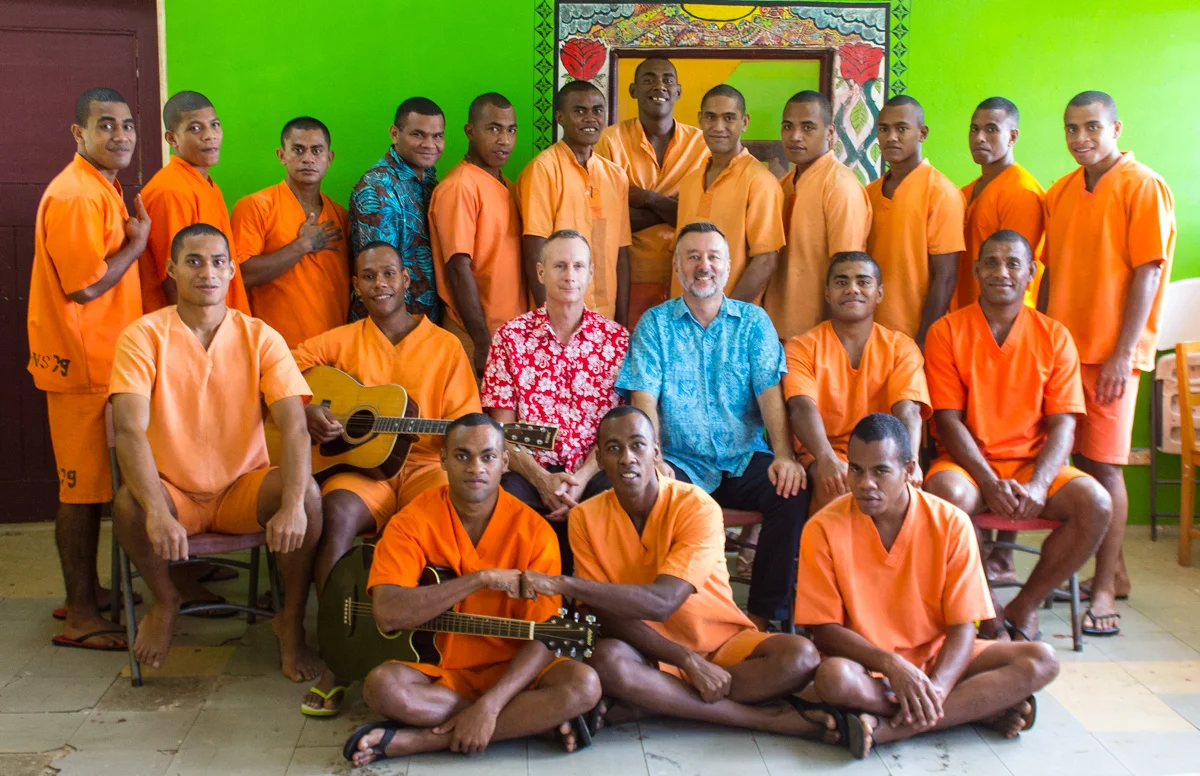
This group of men completing the StepOut-StepFree journey are known for their youthful enthusiasm. What an tremendous experience it has been in leading these 18 young lives.
We shared with you an early invitation to pray for these men and how necessary and powerful that has been. These men have stayed the course and opened their lives and hearts to new understanding.
This group of men completing the StepOut-StepFree journey are known for their youthful enthusiasm. What an tremendous experience it has been in leading these 18 young lives.
We shared with you an early invitation to pray for these men and how necessary and powerful that has been. These men have stayed the course and opened their lives and hearts to new understanding.
Each class spends a portion of each day singing together, a simple act but one that becomes a barometer for what is beginning to take place. This class began as 18 separate voices but over the days they began to sing together, harmonise together and listen to each other. More importantly their singing moved to become an act of worship.
The joy begins in the 'light goes on' moments, where each of the men finds a revelation of personal truth that allows for deep insight, reflection, godly sorrow that leads to salvation. It is these moments interspersed throughout the journey that provide the momentum and build community.
The collective investment in each StepOut-StepFree class is significant. Financially each class runs to around $1000 however it is the spiritual and emotional investment where the benefit to the team becomes incalculable. Sharing life on life, listening, sharing burden, entering grief, remaining vulnerable, hours quietly spent in prayer, maintaining focus while allowing the spirit of God freedom to change the day's plan.
It is in these areas that the integrity of the team and their commitment to Godly restoration becomes our greatest human asset.
These men graduate this Friday, an important milestone in their journey. We trust that these photo's will encourage you further in prayer.


Healing Trauma in Naseibitu
It seemed that every possible climatic event was working against the Operation Foundation teams' visit to Naseibitu Village. Despite more torrential rain in Suva the team set off on a bleak Tuesday morning to visit and lead the village through a 'Healing Trauma Workshop'.
It seemed that every possible climatic event was working against the Operation Foundation teams' visit to Naseibitu Village. Despite more torrential rain in Suva the team set off on a bleak Tuesday morning to visit and lead the village through a 'Healing Trauma Workshop'.
The impact of TC Winston on Naseibitu Village had been significant with structural damage, loss of crops, and most tragically the loss of one of the young men in the village.
Upon arrival the village herald went through the village summoning all to come to the hall. In small groups they arrived and warm welcome's were exchanged.

The men, women and children of Naseibitu Village working on their drawings.
The workshop is conducted in a very interactive style over two hours, with time for group and individual reflection and discussion. Each participant is provided with their own workbook and using simple techniques, opportunity for insight and personal expression takes place.
The feedback at the close of the two hours and over the lunch that followed was encouraging. The village leadership expressed their thanks in the way that this workshop had given new insight and tools in the restoration journey.
Thanks to all who have partnered to make this workshop and these restoring events possible. Lives are being restored!

Enjoying lunch together after the workshop